
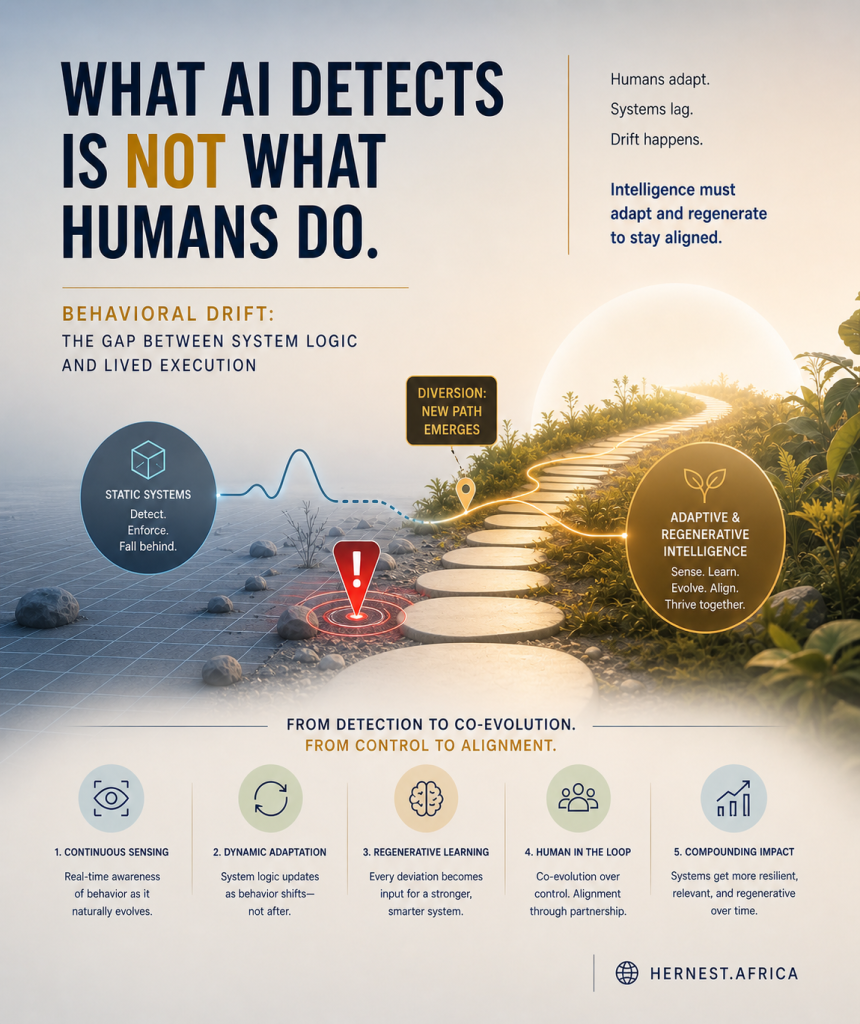
Ride-hailing platforms in Nigeria—Bolt, Uber, and InDrive—have already completed a transition most industries are still theorising about. Human oversight has been replaced, at scale, with algorithmic enforcement. Decisions that were once subjective are now codified into detection systems: cancellation rates, location patterns, dwell time, identity verification, and route consistency. The outcome is efficiency. The side effect is something less discussed and more consequential.
The system has become measurable. And because it is measurable, it has become gameable.
This investigation begins with a simple field interaction: a driver explaining, without hesitation, how the system sees him—and how he has learned to move just outside that field of vision. It expands into a broader pattern: AI does not eliminate undesirable behaviour. It reshapes it into more intelligent forms.
The assumption behind automation is linear. Better detection produces better compliance. The field evidence contradicts this. Detection produces adaptation.
A driver cancels a trip, completes it offline, and reappears at the same destination. The system flags the anomaly. That pathway closes. The driver adjusts. He no longer re-enters from the same location. He drives elsewhere, resets his position, and re-engages the system from a different node. The violation persists. The visibility of the violation decreases.
This is not an isolated workaround. It is a behavioural response pattern. It repeats across actors, spreads through informal networks, and stabilises into a new norm until the system catches up again.
What emerges is a loop:
The platform defines rules and builds detection logic. Users encounter friction and constraint. They begin to test edges—small deviations at first, then more deliberate ones. Successful workarounds spread. The platform updates detection. The system tightens. Users adapt again.
The loop does not break. It escalates.
Most AI systems today operate on two segments of this loop: rule creation and detection updates. They are strong at defining constraints and increasingly effective at identifying known patterns. What they lack is the most volatile layer—the live, shifting behaviour between constraint and compliance.
This is where the system loses resolution.
Each of the three dominant platforms expresses this dynamic differently, but none escapes it.
Bolt operates at scale. It enforces reliability through penalties and a structured point system. Drivers and riders are scored. Behaviour has consequences. Its AI monitors cancellations, idle time, and safety signals. The result is volume with enforced discipline. Yet within this structure, workaround economies emerge. Drivers substitute plate numbers to pass verification checks. They manipulate spatial behaviour to avoid detection triggers. Compliance becomes strategic rather than absolute.
Uber operates with tighter constraints. It enforces quality vehicle standards, service expectations, and environmental control. Its market is narrower, its users more segmented. The system exerts stronger control over experience, less over volume. The behavioural pressure here is different. It is not about evading detection at scale, but about maintaining eligibility within stricter boundaries. Adaptation still exists; it is simply less visible and more selective.
InDrive removes control from pricing entirely. It decentralises decision-making. Price becomes a negotiation between driver and rider. The platform takes a fixed percentage and remains structurally indifferent to the outcome. This creates a different behavioural field. There is less incentive to evade system rules because fewer rules exist. Instead, variability is externalised. Risk, quality, and pricing fluctuate based on individual negotiation power.
These are not just competing products. They are competing behavioural architectures. Each defines a different relationship between control and freedom, and each produces a different pattern of human adaptation.
Across all three, one constant remains. None of the systems fully accounts for adaptive human intelligence in real time.
AI, as deployed in these environments, is reactive. It identifies patterns after they have stabilised. It codifies known behaviours and flags deviations from established norms. Human behaviour under constraint does not stabilise. It mutates continuously. It responds not only to rules, but to the perceived logic behind those rules. It learns the system.
This creates a widening gap between what the system believes is happening and what is actually happening on the ground.
This gap is not noise. It is a signal.
At HerNest, this gap is defined as Behavioural Drift—the distance between system logic and lived execution. It is not visible in dashboards or compliance reports. It exists in conversations between drivers, in small tactical adjustments, in the informal sharing of what works and what gets flagged. It is where policy meets reality and begins to lose fidelity.
Behavioural Drift is not a failure of AI. It is a limitation of static intelligence applied to dynamic systems.
This same pattern extends beyond ride-hailing.
The current discourse around AI risk focuses heavily on the tool. There is sustained concern about AI-generated content, synthetic media, and automation at scale. Regulation efforts concentrate on constraining what the system can produce. Ethical frameworks are being embedded into models. Guardrails are being tightened.
The field reality points elsewhere.
AI does not independently initiate distortion. It executes human intent with increasing efficiency. The rise in synthetic media—fabricated videos, artificial personas, simulated environments—is not a product of autonomous systems. It is a product of human use.
The consequence is already visible. Digital environments are becoming harder to trust. Users encounter content that requires verification before acceptance. Synthetic visuals blend with real ones. Fabricated narratives circulate alongside factual information. The cost of discernment increases.
This produces a secondary effect. Participation begins to shift. Individuals become more cautious about what they share. Visual identity becomes a liability when it can be replicated, altered, or redeployed without consent. The system does not collapse. It degrades in reliability.
This is the same structural pattern observed in ride-hailing systems. Enforcement improves. Behaviour adapts. The system tightens. Adaptation becomes more sophisticated.
Focusing solely on constraining the tool repeats the same loop at a different scale.
The leverage point is not the tool. It is behaviour.
A system designed to operate in this reality requires a different architecture—one that assumes adaptation as a constant, not an anomaly.
Three structural shifts define this transition.
Systems must move from static detection to continuous sensing. Logs capture what has happened. They do not capture how behaviour is evolving. Continuous sensing requires integrating field intelligence—qualitative and quantitative signals that reveal how users are interacting with, bypassing, or reshaping the system in real time.
Enforcement must evolve into adaptive feedback loops. Detection cannot remain a terminal action. It must become an input into system redesign. The time between identifying a new behaviour and updating system logic must be compressed. Without this, Behavioural Drift expands.
Verification must move from static artefacts to dynamic validation. Any system that relies on fixed proofs—images, documents, single-point identifiers—creates a substitution vulnerability. Validation must occur across time and signals: movement patterns, usage consistency, relational data, and anomaly correlation. Identity becomes a pattern, not a snapshot.
What emerges is an adaptive intelligence infrastructure. A system that learns at the same rate as its users. A system that does not aim to eliminate evasion, but to continuously reduce its viability.
The implication is clear. Efficiency is no longer the differentiator. Responsiveness is.
The platforms that dominate the next phase will not be those with the most rules or the most advanced detection models. They will be those who maintain the smallest gap between system logic and human behaviour.
The difference is awareness.