This article proposes a framework for understanding nonprofit sustainability as fundamentally a systems design challenge. Burnout, founder dependency, internal conflict, mission drift, and board dysfunction are reframed as structural patterns — predictable, recurring, and solvable through architecture rather than personality alone. Drawing on one of the most sophisticated governance models in pre-colonial Africa — the Yoruba system — the framework translates ancient institutional design into a practical five-layer architecture for modern nonprofits. The Yoruba system is examined as a federated, dual-layer operating system that treated emotional intelligence as systemic infrastructure rather than an individual skill. The paper introduces a translation framework mapping Yoruba governance mechanisms (the Oba, the Oyo Mesi council, the Ifá system, age grades, guilds, and community assemblies) to modern nonprofit equivalents, and argues that every mechanism addressed a specific human vulnerability: ego, fatigue, conflict avoidance, knowledge hoarding, and emotional overload. The framework is applied to a phased implementation roadmap and concludes with a call for nonprofit leaders to design institutions that thrive on exceptional architecture — built for real, imperfect, extraordinary human beings.
1. Introduction: The design opportunity everyone overlooks
The prevailing misconception about nonprofit struggles is that they stem from bad leadership or insufficient funding. The deeper truth is that burnout, founder dependency, internal conflict, mission drift, and board dysfunction are structural patterns — symptoms of systems design gaps, disguised as leadership crises.
These patterns recur with striking predictability across organizations of every size, sector, and geography. And they point toward a powerful opportunity: what if we could learn from societies that had already addressed many of these challenges — centuries before modern organizational theory existed?
When emotional intelligence is treated as infrastructure rather than personality, institutions become more adaptive, more humane, and more capable of lasting beyond the people who start them.
This paper examines one of the most sophisticated governance architectures in pre-colonial Africa — the Yoruba system — and translates its structural principles into a practical framework for modern nonprofit design. This is engineering analysis, grounded in cultural intelligence.
The Yoruba system endured colonization, the transatlantic slave trade, religious displacement, and political fragmentation — because its architecture was resilient by design. When one node was disrupted, the whole structure continued to function.
That principle alone has more to offer modern nonprofits than the majority of contemporary management literature.
2. The Yoruba governance architecture
Before translating Yoruba principles into modern structures, it is essential to understand the original architecture on its own terms. What stands out, when studied closely, is how much attention was given to structure — designed specifically for human behavior, emotion, and continuity over time.
2.1 Modular, decentralized governance (anti-collapse design)
The Yoruba system was a federation, where every town (ilu) functioned autonomously, yet all towns shared common laws, cosmology, language, and ritual logic. This meant governance could adapt locally while remaining coherent across a vast geography.
Power was distributed across multiple interdependent nodes, each with its own domain of authority and its own constraints:
- The Oba (symbolic authority)
- The Council of Chiefs (decision-approval authority)
- Age grades (rotated civic responsibility)
- Guilds (specialized economic self-governance)
- Spiritual authorities (ethical oversight)
This distribution made the system resilient — when one node was disrupted, the rest of the structure absorbed the impact and continued operating.
This is the same logic modern blockchain and distributed systems aim to replicate.
2.2 Dual-layer architecture: spiritual OS + physical OS
Yoruba society ran on two synchronized operating systems — one spiritual, one physical — and every significant decision required aligning both.
The Spiritual Layer (Ifá) functioned as the decision-making protocol, ethical governance system, and predictive intelligence framework. It was a symbolic database containing 256 Odu, each encoding history, psychology, moral consequence, and probability outcomes.
The Physical Layer comprised markets, law, trade, warfare, and urban planning. It was the operational arm of governance — the execution layer. And it always operated in alignment with the spiritual layer’s ethical check.
This dual-layer architecture meant that decisions were always subject to both practical assessment and ethical reflection. That is systems alignment — a design principle with enormous modern relevance.
2.3 Ifá as a computational framework
Ifá is a symbolic database system of extraordinary sophistication. The 256 Odu represent combinatorial logic. Each Odu contains history, psychology, moral consequence, and probability outcomes.
This is Bayesian reasoning. Scenario modeling. Ethical AI — achieved through human cognition, long before machines.
2.4 Power was constrained by architecture
Yoruba kings (Oba) were architecturally constrained in every direction. The Oba served as the symbolic head of authority, and that authority was bounded on every side.
- The Council of Chiefs (Oyo Mesi) could override the Oba’s decisions and, in significant cases, initiate leadership transition.
- Spiritual authorities provided ethical oversight independent of political power.
- Age grades rotated civic responsibility, ensuring that the weight of governance moved across generations.
- Guilds (Egbé) maintained economic self-governance, holding specialized knowledge and trade authority within their own domain.
- Community assemblies preserved the collective voice, creating formal channels for dissent and social correction.
In the Oyo Empire, even the Alaafin was held accountable by institutional design. This is constitutional governance before constitutions. It is also, critically, emotional governance — because it anticipated the human tendencies toward excess, ego, and fatigue, and designed structural countermeasures.
2.5 Culture as a data-transmission system
Stories, proverbs, chants, and festivals in Yoruba society were functional infrastructure for memory storage, legal precedent, ethical reinforcement, and behavioral training.
- Proverbs were compressed wisdom packets — portable, memorable, and actionable.
- Songs were emotional encoding — embedding values in affect so they traveled further than instruction alone.
- Rituals were system updates — processing grief, transition, and celebration at the collective level.
- Festivals were behavioral training — reinforcing social norms through shared experience rather than top-down mandate.
Every cultural element served a structural function. Everything was intentional.
Meaning, when emotionally encoded, travels further than instruction.
3. The translation framework: Yoruba architecture to modern nonprofit
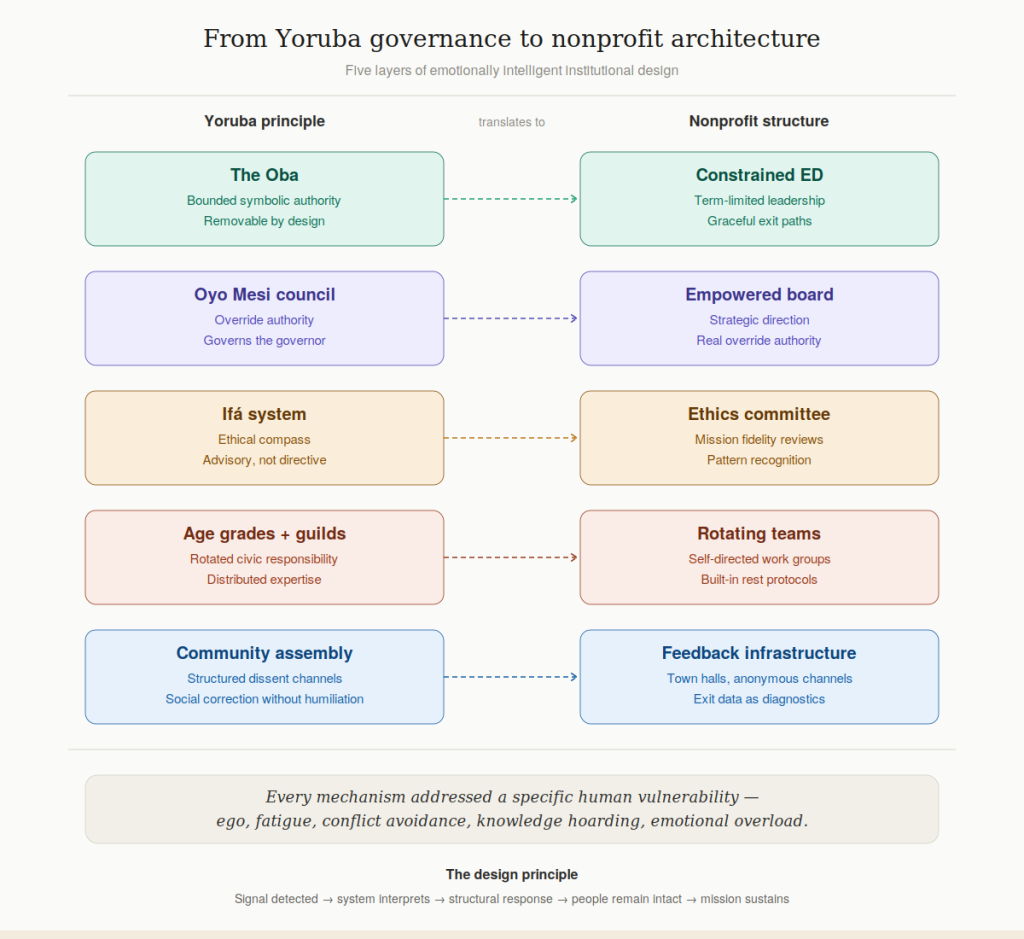
The following framework translates Yoruba governance principles into a practical nonprofit architecture. Each traditional element maps to a modern structural equivalent, preserving the original design logic while adapting to contemporary organizational contexts.
The core insight: every Yoruba governance mechanism addressed a specific human vulnerability — ego, fatigue, conflict avoidance, knowledge hoarding, or emotional overload. Modern nonprofits face the same vulnerabilities. The mechanisms can be translated; the principles are ready to be applied.
[See diagram: From Yoruba Governance to Nonprofit Architecture]
3.1 Layer 1 — Executive governance (the Oba principle)
The Oba was the visible head of the community — the symbolic center of authority. And the Oba’s power was always bounded. The Oba could be transitioned. The Council could override. Rituals channeled excess. The Oba represented the institution — and the institution was always larger than any single leader.
Nonprofit translation: The structurally supported executive director. In many nonprofits, the Executive Director becomes the institution — carrying the vision, the relationships, the emotional weight, and the operational knowledge. When they depart or experience burnout, the organization fractures.
The Yoruba model offers an alternative architecture: term-defined executive leadership, symbolic authority separated from operational control, graceful transition pathways, and documented institutional knowledge. Leaders can move between roles while remaining part of the community.
3.2 Layer 2 — Strategic oversight (the Council principle)
The Oyo Mesi (Council of Chiefs) held decision-approval authority. They could override the Oba, ensure accountability, and protect the community’s interests against executive overreach. They governed the governor — while the governor governed operations.
Nonprofit translation: An engaged, empowered board. The Council principle invites a board that owns strategic direction, holds genuine override authority, and separates decision preparation from decision approval. The board sets boundaries and defines what the organization will pursue — while staff prepare recommendations and the board evaluates them. This creates a reflective checkpoint before irreversible actions.
3.3 Layer 3 — Mission fidelity (the Ifá principle)
Ifá was interpretive authority — the system’s ethical compass. The Babalawo (Ifá priest) read patterns, offered counsel, and flagged misalignment. Critically, the Babalawo held advisory power, separate from governance. This separation is precisely what gave the counsel its weight and trustworthiness.
Nonprofit translation: The advisory / ethics committee. The Ifá principle translates to an advisory committee composed of community members, former beneficiaries, and subject-matter experts — with the mandate to conduct mission fidelity reviews, surface pattern recognition, and interpret systemic signals that operational leaders may be too close to see. Their power is in their independence.
3.4 Layer 4 — Distributed operations (age grade and guild principles)
Age grades rotated civic responsibility through generational cohorts, ensuring that the weight of governance moved across generations organically. Guilds (Egbé) held specialized knowledge and economic authority, operating with significant autonomy within their domains.
Nonprofit translation: Rotating teams and self-directed working groups. Sustainability comes from rotation, and expertise flourishes when distributed. Key operational roles rotate on defined cycles. Cross-functional teams manage their own processes. The work that carries the heaviest emotional weight — fundraising, crisis response, community mediation — is explicitly shared and rotated. The system builds in recovery. People know when they will rotate out, and transitions are planned and supported.
3.5 Layer 5 — Structured feedback (the Community Voice principle)
Community assemblies were the system’s feedback mechanism. Dissent surfaced structurally — through recognized channels — creating space for course correction before tension accumulated. Social adjustment happened with dignity. The system processed dissent and channeled it into institutional learning.
Nonprofit translation: Formal feedback infrastructure. Structured town halls where staff, volunteers, and community members can raise concerns and propose changes. Anonymous escalation channels that are genuinely confidential and visibly acted upon. Exit interviews treated as system diagnostics — every departure carries information. And space for disagreement within governance, so that tension finds constructive outlets rather than building pressure.
4. Emotional intelligence as structural infrastructure
The defining feature of Yoruba governance was its treatment of emotional dynamics — as systemic forces to be designed around, rather than individual qualities to be developed.
In many modern nonprofit models, emotional intelligence is treated as a personal skill. When things become difficult, the response is training, mediation, or personnel change. The system itself remains emotionally unaware.
Yoruba systems took a fundamentally different approach. Emotional load was distributed across the system. Decision-making, accountability, conflict resolution, and leadership were layered so that the emotional weight of the institution was shared structurally.
4.1 The early warning system
Yoruba systems paid attention to subtle signals long before visible disruption. The same signals exist in every nonprofit — they simply await recognition:
- Silence or withdrawal — people who were once vocal become quiet.
- Repeated conflict patterns — the same disagreements resurface across different people and contexts.
- Participation shifts — meeting attendance, volunteer hours, and engagement metrics change.
- Ritual fatigue — shared practices (team meetings, retreats, celebrations) lose meaning and feel perfunctory.
These are system signals. When treated as data, they allow the organization to self-correct early and with care.
The response pattern evolves from: Crisis occurs → founder absorbs → ad hoc mediation → burnout accumulates → turnover → drift.
To: Signal detected → system interprets → structural response activates → load is redistributed → people remain intact → mission sustains.
When emotional intelligence is built into structure, it becomes the organization’s immune system — responding early, proportionally, and with precision.
5. Organizational culture as infrastructure
Many nonprofits underestimate the role of culture in organizational sustainability, relying instead on policies, reports, and strategy decks — tools that rarely shift behavior on their own.
Yoruba systems understood a deeper truth: culture is infrastructure.
| Yoruba mechanism | Function | Nonprofit equivalent |
|---|---|---|
| Proverbs | Compressed wisdom; portable decision-making aids | Core values as memorable, actionable phrases |
| Rituals | System updates; processing grief, transition, celebration | Structured retrospectives, onboarding ceremonies, departure rituals |
| Oral histories | Memory storage; institutional continuity | Story archives and organizational narrative |
| Festivals | Behavioral training; social norm reinforcement | Retreats designed around renewal, shared identity |
| Songs / Chants | Emotional encoding; values embedded in affect | Emotionally resonant storytelling in communications |
Every proverb, song, and ritual in the Yoruba cultural system served a structural function. Modern nonprofits benefit from asking the same question of every cultural practice: what is this doing for the system?
6. Why it still scales
Yoruba systems endured colonization, slavery, religious replacement, and political fragmentation. The reason is architectural: architecture outlasts rulers.
When a system is well-designed, people can leave, transition, or face disruption — and the system continues to run.
The real tragedy is that modern Africa moved away from its strongest architectures and adopted imported models that extract without offering coherence. The translation offered here requires understanding the principles that made Yoruba systems resilient — and applying those principles to modern structures, in modern contexts, for modern challenges.
7. Implementation roadmap
Translating these principles into practice requires a phased approach. The following roadmap is designed for nonprofit leaders and board members ready to restructure their organizations around Yoruba-informed architecture.
Phase 1: Diagnostic
Begin by mapping where emotional load currently lives in the system. Ask: Who carries the most emotional weight — and is that by design or by accident? Where does dissent go — does it surface structurally, or does it move through informal channels? What happens when the Executive Director steps away for two weeks — does the system sustain itself? What signals is the system already producing that await attention?
This diagnostic phase requires honest observation, and it can begin immediately — before any new structures are introduced.
Phase 2: Structural adjustment and cultural infrastructure
Introduce the first architectural changes: establish an Advisory Committee (Ifá principle) — recruit three to five external voices who will review mission alignment quarterly. Define term structures for the ED role (Oba principle). Create formal feedback channels (Community Voice principle) — anonymous surveys, structured town halls, and documented exit interviews. Begin rotating one key operational role (Age Grade principle).
Simultaneously, build the cultural layer: articulate three to five core values as memorable, actionable principles — phrases that staff can use in real-time decisions. Design team rituals with genuine emotional function — onboarding ceremonies, structured retrospectives, departure rituals. Begin documenting institutional stories and lessons learned. Plan the first annual retreat designed around renewal and reflection.
Phase 3: Integration and monitoring
Embed emotional intelligence tracking into the organization’s regular operations. Track emotional signals alongside financial and operational metrics. Review feedback patterns quarterly with the Advisory Committee. Adjust role rotations based on observed stress patterns. Treat every departure as diagnostic data — as valuable information that strengthens the system’s self-awareness.
8. Conclusion: Architecture that honors people
The Yoruba governance system endured because its architecture was designed for imperfect, emotional, finite human beings — and it worked. It thrived precisely because it anticipated human nature and built support structures around it.
Modern nonprofits can draw directly from this design philosophy. The challenges they face — burnout, founder dependency, mission drift, internal conflict, board dysfunction — are ancient challenges. And they have already been addressed, architecturally, by societies that took human nature seriously in their institutional design.
When a system is well-designed, people can leave, grow, or transition — and it still runs. That is the ultimate measure of organizational sustainability.
Sustainability is about anticipation — anticipating human limits, emotional shifts, and power dynamics, and designing with them in mind. Building systems that support people rather than depending on their perfection.
This is what it means to treat emotional intelligence as infrastructure. And it is a lesson nonprofit systems can still draw from African architecture today.
Tessy Egonu Systems Architect | Emotional & Behavioral Intelligence Researcher | Sustainable Nonprofit Systems Designer